

Silver Arrows Revisited, Part 1: Auto Union’s 1934 Grand Prix Entrance Foreshadowing F1

by: Steve Johnson, photos by Audi and Mercedes-Benz
2024 marked the 90th anniversary of Auto Union competing their first season of grand prix competition. In 2026 Auto Union, now Audi, will enter modern day grand prix racing, Formula 1, when a new rule set and corresponding formula takes effect because, “Formula 1 is both a global stage for our brand and a highly challenging development laboratory”, as communicated by the brand.
In that, it seems the first part of Audi’s reason today is the same as it was for the newly-formed Auto Union, in addition to the German government in 1933. In order to delve more deeply, we should turn back the clock.
Seeking to elevate Germany’s presence in Europe, the German Transportation Minister announced that funding to the tune of 450,000 Riechsmarks, equivalent to over $25 million US Dollars (USD) or $34 million Canadian Dollars (CAD) today, would be made available to companies designing and constructing grand prix cars. An additional 50,000 Riechsmarks was promised in the form of success-related bonuses. But what was the logic behind this influx of money at that particular moment in time?

The 750 Kilogram Formula
Whenever a new racing formula, or the rule set a racecar must conform to, is introduced this presents an opportunity for manufacturers. In the late 1920s, racecar chassis development was underfunded thus stagnated. Manufacturers turned to increasing engine size and power output in order to go faster. Attempting to curb the dangers of subsequent rising speeds, the International Association of Recognized Automobile Clubs (AIACR, the father of today’s Fédération Internationale de l’Automobile or FIA) announced a new formula in late 1932 for the 1934 Grand Prix season, calling it the 750 Kilogram Formula. The rules limited a racecar’s weight to 750 kg, calculated excluding the weight of the driver, fluids and tires. The idea was to effectively ban large displacement engines. There was no restriction on the fuel that could be used. Dimensional aspects of the new formula were included to control a designer’s ability to minimize a car’s frontal area. It wasn’t an exacting formula, but one that allowed for innovative designs.
Taking advantage of and splitting the German government funding, Auto Union and Mercedes-Benz designed state-of-the-art racecars that ushered in a new period of exciting racing. Professor Ferdinand Porsche, whom Wanderer commissioned in 1930 to design a road car, subsequently discussed designing a racecar for that brand. After the Auto Union merger brought Wanderer into the four rings, Professor Porsche now worked on behalf of Auto Union AG to design a grand prix car to the 750 Kilogram Formula. Designated the Type 22 within Auto Union, the racecar’s unusual feature was locating its 4.4-liter, V16 engine behind the driver. This position allowed for a short, flat nose and tapered rear that gave the Type A an unusual appearance. It almost appears as if it’s running backwards on track.
To comply with the weight-driven formula, lightweight metal alloys were needed to construct both the racecar’s body and engine. Underneath its body panels, some even made from doped fabric like aircraft of that day, was a tubular frame holding the narrow 45-degree 16-cylinder engine. It used a single camshaft to work the inlet valves directly while the exhaust valves worked via pushrods. The V16 configuration made for considerable rotating mass, thus a relatively slow-revving engine. But it produced 391 lb-ft of torque at 2,700 rpm and 295 hp at 4,500 rpm yielding a wide, useable power band. The key to the power output was a Roots-type supercharger providing forced air induction.
In November 1933 the first of five Type As or P-Wagens (short for “Porsche-Wagens”) was completed at Horch’s factory in Zwickau, Germany. After a few shakedown runs in the local area, formal testing began in November 1933 at the Nürburgring driven by Team Manager Willy Walb. Even though the track was closed to the public for the test, German magazine Autocar reported the V16 engine, “…had the world’s most tremendous exhaust note”. Final preparations for the 1934 race season were completed in January at the legendary Monza circuit in Italy and also on the autostrada between Milan and Varese to assess the Type A’s top speed.

Record-setting debut
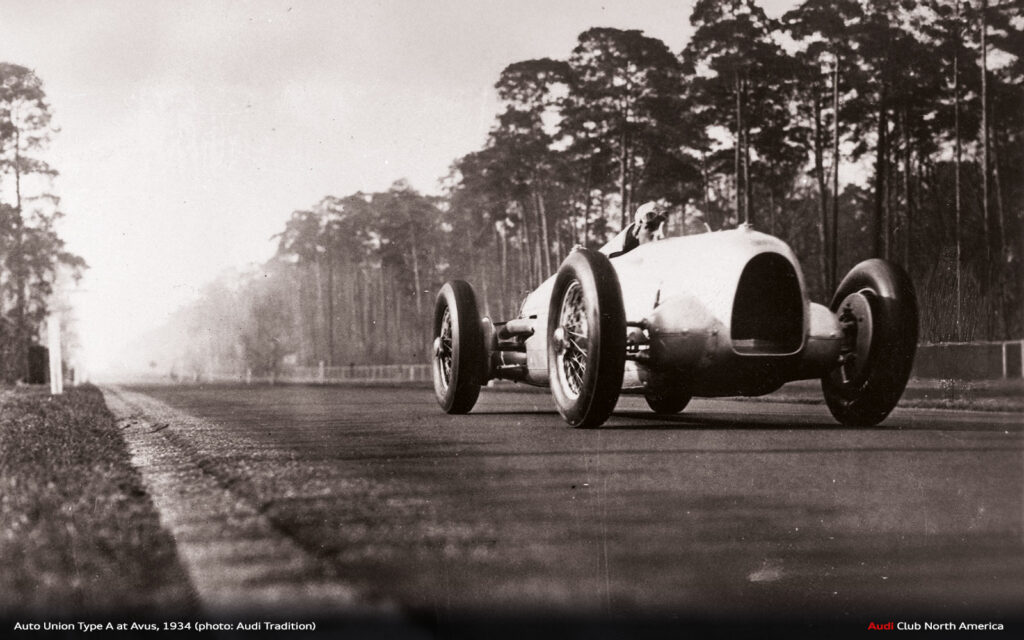
What better way is there to unveil a new racecar and make a name for yourself than to attempt new world speed records? The Type A made its first public appearance when driven by Hans Stuck (father of Audi Trans-Am and IMSA race driver Hans-Joachim Stuck) on March 6, 1934, at the AVUS circuit just outside Berlin. AVUS, more formally the Automobil Verkehrs and Übungs-Straße (automobile traffic and training road), at that time was really just a 12.16-mile straightaway with banked turns at both ends to allow return runs. It was perfect for Hans’ mission that Tuesday, he set three new Class C world records reaching a top speed of 164 mph in the process. Stuck averaged 134.93 mph over a one hour period for the first record, averaged 134.76 mph over a 100-mile distance for the second record and finally averaged 134.88 mph over 200-kilometers for the third. Debut successful, it was time to race.
The 1934 Grand Prix season
At this time not all grand prix races shared the same status. Six races sanctioned by the AIACR had the top status of Grand Épreuves or Grand Trials. The race in Monaco and the Indianapolis 500 also shared this elite title. The Type A’s first race was in a lesser grand prix, the Fourth International Avusrennen race on May 27, 1934. Three cars numbered 42, 44 and 46 were entered driven by Hans Stuck, Hermann zu Leiningen and August Momberger, respectively. Returning to the track where he’d just set records, Stuck started fourth while zu Leiningen and Momberger were eighth and ninth on a grid of 11 cars.
In wet conditions, Hans Stuck had a 73-second lead after only two laps of the 15-lap race. But once the rain stopped and the track dried, his competitors began to close the gap until Hans pitted on lap 11 for tires and fuel. In what would seem like an eternity today, his pit crew got the job done in 1 minute and 22 seconds during which time he was passed for the lead by eventual winner Guy Moll driving an Alfa Romeo. But not even second was in the cards for Stuck who retired with a clutch issue on lap 12. As for his teammates, Momberger stood on the podium in third place and set the fastest lap, but zu Leiningen shared a similar fate as Stuck retiring on lap 7 with a broken radiator.
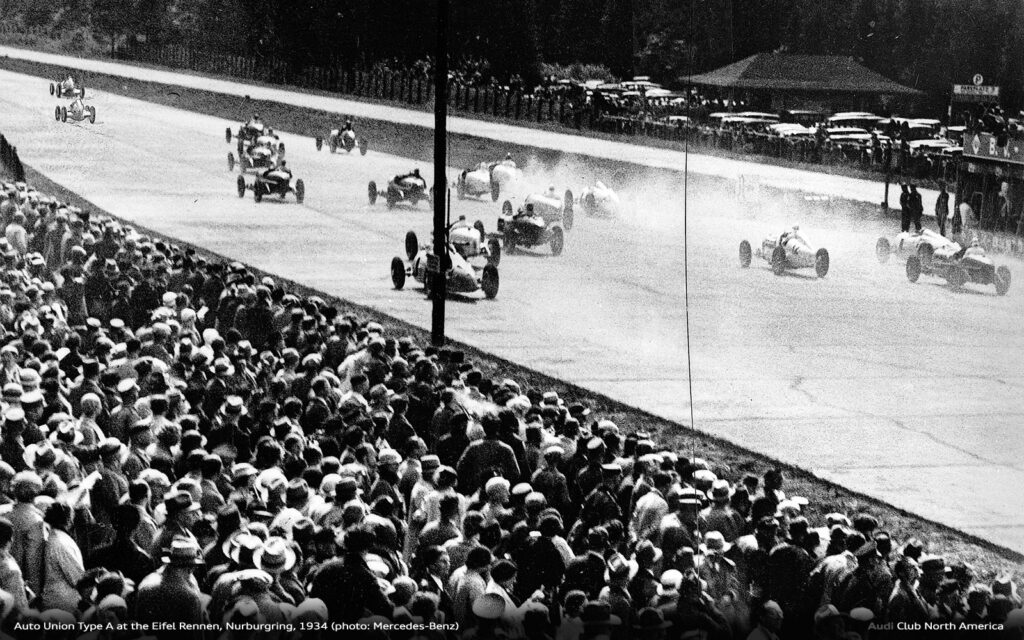
Auto Union’s Type As were back two weeks later for the annual Eifelrennen race at the Nürburgring. Hans Stuck had a bit of racer’s luck that day thanks to team orders between the Mercedes-Benz Team Manager Alfred Neubauer and their driver Luigi Fagioli. With their two W25s running first and second as driven by Fagioli and Manfred von Brauchitsch, it seems a first Mercedes-Benz victory wasn’t desired with an Italian driver. Neubauer called Fagioli into the pits moving von Brauchitsch into the lead and Stuck into second. When Fagioli left the pits, furious over the situation, he parked his W25 on track and walked back. The Mercedes-Benz cover story was an engine misfire caused the retirement. Momberger also retired due to a fuel feed problem and zu Leiningen retired his Type A with an unspecified mechanical issue.
French Grand Épreuves on July 1, 1934
The Type A’s third race marked its first public appearance outside of Germany. The three Auto Union teammates were slated to be on the starting grid but a problem with Stuck’s car saw him race Momberger’s car while he in turn raced zu Leiningen’s car. Their target was to complete 40 laps of a 12.5 kilometer circuit, but neither hit the mark. After a poor start but reaching the lead by lap 3, Stuck’s car had a water pump problem and he couldn’t maintain the pace of his rivals. The Type A’s V-16 held on for 32 laps before calling it a day. Momberger’s race was much shorter as he dropped out with a suspension failure after only 10 laps. In fact, all the German cars suffered mechanical failures that day. They proved they were fast with both Auto Union and Mercedes-Benz setting new lap records in practice, but thus far, their reliability was problematic.
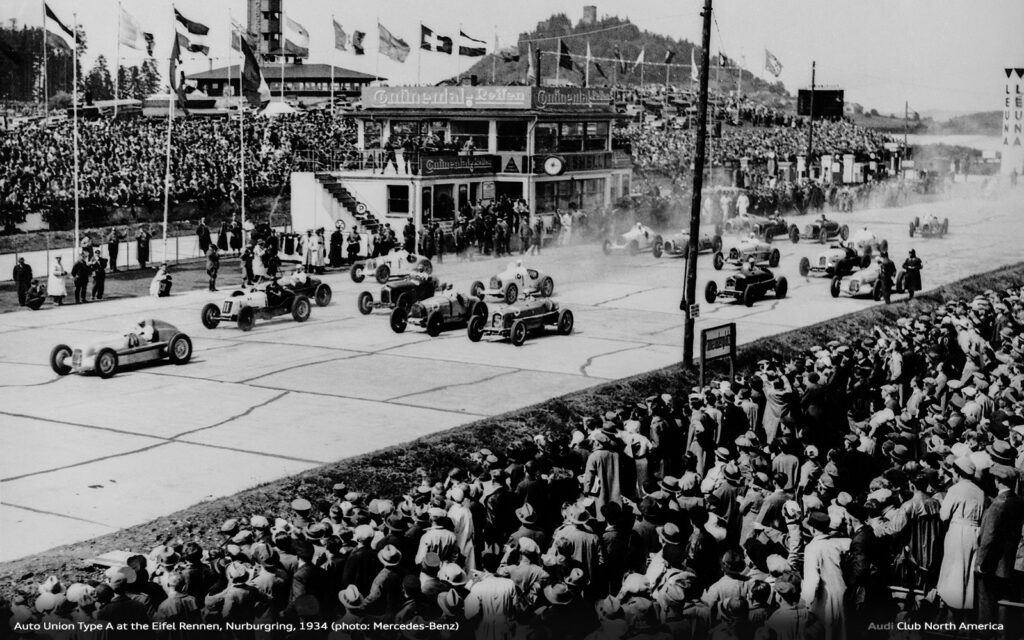
German Grand Épreuves, July 15, 1934
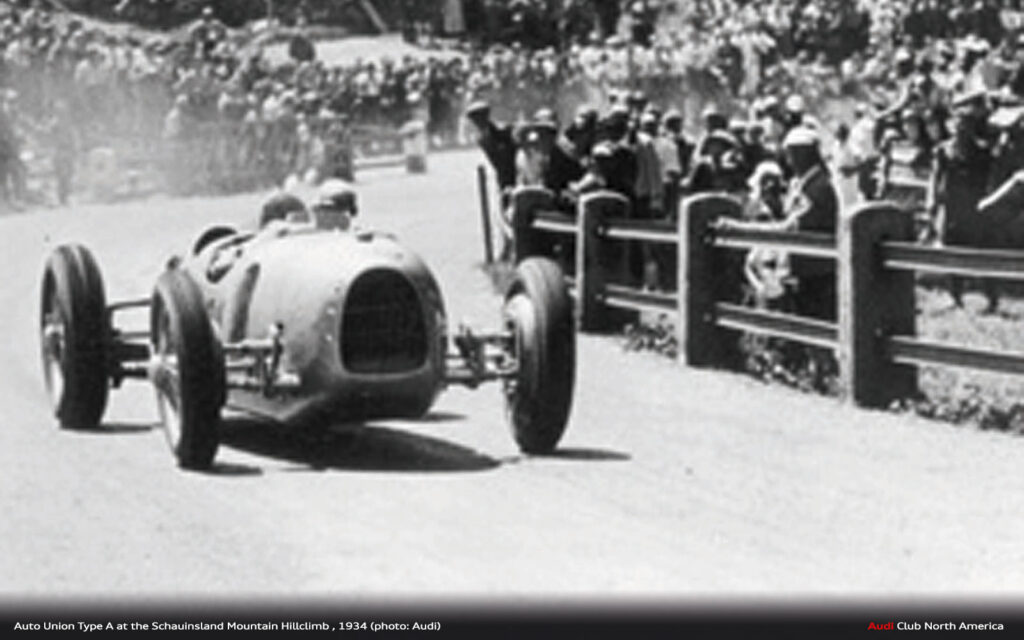
There’s no better place to win a race than in your home grand prix and Hans Stuck did just that for himself and Auto Union on this day. Not surprisingly, it was an overcast, rainy day in the Eiffel Mountains at the Nürburgring circuit when Auto Union drivers Stuck, Momberger, and Ernst Burggaller took grid positions 10, 15 and 18 to start the race. The 25-lap, 570.25 km race distance over a constantly changing course would test the Type A yet again. But not only did Hans Stuck pass the test by winning, he set the fastest lap at 10:43.8. That time would still be respectable today on a track now roughly 2 km shorter. Unfortunately, the two other Type As failed the test dropping out on the fourth and twentieth laps with more mechanical problems. This was at a time, however, when races would typically see half the field fail to finish. On this day, 58% of the cars that took the grid ended their days without seeing the checkered flag.
Bureaucracy or Politics?
The next race for the Auto Union team was to be at the Belgian Grand Épreuves at Spa-Francorchamps on July 29th. At this time the circuit was 14.9 km in length. The Type A was denied the chance to race due to a Belgian Customs decision. Going back to the 750 Kilogram Formula, teams were allowed to use any fuel and the Auto Union fuel contained alcohol. Not the drinking kind, but Customs officials still demanded the team pay 180,000 Belgian Francs duty (roughly over $4,800 USD/$6,500 CAD today) to enter the country. Declining to pay, the team withdrew from the race saying they elected to rest their drivers. It doesn’t seem like a lot of money, but it was certainly the principle.
After a blown piston ended Hans Stuck’s Coppa Acerbo race in the Italian port city of Pescara in mid-August, Auto Union’s next race was the first running of the Swiss Grand Prix at the new Bremgarten circuit near Bern. A 7.28 km lap distance would result in 509.6 km race distance after 70 laps. Three Type As, piloted by Stuck, Momberger and zu Leiningen, were entered and Stuck and Momberger took a 1-2 finish for the team. Different sources credit fastest race lap to both Momberger and Stuck at 94.2 mph and 90.47 mph, respectively. Either way, it was set by a Type A, both of whom lapped the entire field. The downside to the weekend was zu Leiningen’s retirement due to a gearbox failure on lap 18.
Italian Grand Épreuves, September 9, 1934
The previous year’s race saw three top contenders die in two crashes so track officials made a significant change for 1934. They switched to the shorter Florio road and track circuit and introduced two tight hairpins and two double chicanes to slow the racers. This layout resulted in the slowest race ever at Monza with a winning time of four hours, 45 minutes and 47 seconds and that win going to a Mercedes-Benz. For Auto Union, the driver line-up remained the same. Stuck was leading the race when the Type A’s engine cooling system design on a hot Italian late summer day became a big problem for him.
The Type A used its chassis tubes to carry hot coolant between the engine and radiator. The tubes conducted heat into the gas, brake, and clutch pedals resulting in burns to Stuck’s feet forcing him to pit. Hermann zu Leiningen took over the car while first aid was given to Stuck. After wrapping in bandages, Hans’ feet wouldn’t fit into his racing boots so shoes were actually borrowed from an Italian policeman for him to wear when he got back in the car replacing zu Leiningen to eventually finish second. In spite of all the drama, Stuck managed to set the fastest lap at 2:13.6 during this marathon of a race.
Even with the worsening political situation in Spain, 1934’s final Grand Épreuves was held on September 23. The drivers would again be Stuck and zu Leiningen. After taking the initial lead, Stuck’s car ruptured an oil line on lap three prompting Team Manager Willy Walb to replace zu Leiningen with Stuck who finished just off the podium in fourth but once again set the fastest lap time.
On September 30 at the season’s last race Hans Stuck regained his winning ways at the Masaryk Circuit at Brno in then Czechoslovakia. Fellow Auto Union drivers Hermann zu Leiningen finished fourth and Wilhelm Sebastian finished seventh, albeit a lap down, demonstrating the Type A’s reliability was improving. This course, the longest used in the 1930s, is named after the Czech President Jan Masaryk, but this grand prix is best remembered for the extremely unusual entry and unfortunate demise of one Josef Brázdil. The man had no racing experience yet was allowed to enter a new and very competitive Maserati 6C-34. Other competitors complained of his lack of driving skill during Wednesday’s practice and that night he was arrested but released on bail until he completed the event. Sadly, he wouldn’t even see the green flag. His fatal accident came during Thursday’s practice in the course’s high-speed section known as the U Krize kink. While it may have been fast, this section didn’t require much driving skill thus leading to speculation that his crash was actually a suicide.
While GP racing was over for the year, Auto Union wasn’t ready to park their highly-successful Type A model just yet. So they returned to the site of its debut, AVUS, to attempt more world speed records. On October 20, Hans Stuck set five Class C records going from a standing start. By the end of the day Auto Union would own the 1 km, 1 mile, 50 km, 50 mile, and 100 km distance records at speeds ranging from 101.56 mph up to 152.18 mph.
The 1934 Grand Prix season represented a fundamental power shift in the racing world. With the 750 Kilogram Formula’s introduction, the dominant Italian brands and teams of the 1920s were dethroned by the Silver Arrows from Germany. Fast-forward to now, the major rule changes coming to Formula 1 in 2026 present Audi with an opportunity to once again, upset the status quo. To pique your interest in Audi’s F1 endeavor, we’ll cover numerous aspects of Auto Union’s racing campaign in the 1930s in upcoming issues of quattro magazine. We hope to discover that at least some of what was true ‘back-in-the-day’ is still true today and specifically that history, in the form of racing success, will repeat itself.




Responses