

VW Group Executives at LA Auto Show Hint at Future of Compact Audi EV Performance Cars Including Possible Manual Transmission

We caught a couple of stories post Los Angeles Auto show centering on Volkswagen. Given the nature of any automotive portfolio such as the vast Volkswagen Group, hardware considerations for platforms also shared by Audi models is always an interesting thing to take note of because such hardware can play the basis for Audi’s own engineers in bringing to market their own take on the tech.
Much of this centered around Volkswagen EVs, so MEB-based cars in the short-term (Audi Q4, VW ID.4, ID.Buzz, ID GTI), and SSP (Scalable Systems Platform) that will underpin everything from the smallest compacts to the largest / most luxurious to highest performance hypercars.
Whether or not Audi brings more to market then on the MEB as we know it with the Q4 e-tron, or waits until SSP remains to be seen. Even still, we can assume that EV entries to cover the breadth of the lineup are coming. In fact, they’re already here with the launch of the A6 e-tron, so the inevitability of a B-segment A4 e-tron or A-segment A2 or A3 e-tron seems obvious.
In that vein, let’s focus on what was said.
VW R&D boss Kai Grünitz told Autocar Magazine to expect improvements in battery costs and overall performance and new functionality on its MEB-based cars.
He also said development of SSP is continuing, which we assume would be the next-generation of cars as the MEB architecture gets phased out. It’s this generation of cars that will significantly benefit from the join development project with Rivian thanks to that EV brand’s electric architecture and “best in class” over-the-air updates.
“They are much leaner and faster than traditional OEMs,” Grünitz told Autocar. “They’re closer to what we see in China. We combine that with our knowledge of building cars to high-quality standards, so I think this is a good combination.”
Kai Grünitz also chatted with MotorAuthority, revealing a few more details regarding Volkswagen’s future EVs. This included confirmation that Volkswagen has tested a “manual transmission for EVs”. Grünitz shared that he didn’t like the solution because it makes sense to stick to one gear, but that “there is an option” when considering how cars like the GTI or Golf R and referencing the Hyundai Ioniq 5N.
On this subject, Volkswagen’s R&D boss also spoke to sound. In the case of the GTI, it “has to create emotions” and for that “you need sound”. He offered the notion of a “GTI Mode” for an EV GTI, something that produces sound and “other functionalities”. That all sounds great, but it’s the rest of the quote mentioning functionality that would “remind you of a sporty vehicle” where we hope this isn’t anything more than a statement lost in translation.
For EVs to be credible in the performance space, they nee do more than remind driving enthusiasts of sporty vehicles. They need to authentically be sporty vehicles. They’re not going to be traditional ICE performance cars, but they don’t need to be. They just need the fundamentals.
What are those fundamentals? In our opinion, sound doesn’t just evoke emotion. Yes, it does that too, but sound is also a language spoken by the vehicle to communicate with the driver. A driver working as one with the car uses engine note to know critical things like speed, adhesion, need for ratio change that does mean gear changes traditionally but also controls weight shift that can be managed through simulated gears… just as Ken Block learned in the S1 Hoonitron as it evolved from Las Vegas to Mexico City shoots.
That’s kind of the problem right now. Elements like sound are thought of as purely props in creating a synthesized experience, when they should be thought of as a language of communication in the driving experience. Allowing for some drivetrain whine conflicts with the idea of quiet cruising on a commute, yet it could be remarkably authentic (versus piped in sound effects) in pursuit of a purist EV driving experience.
There’s also weight. EVs will always be hampered as a platform for driving enthusiasts so long as they are obnoxiously heavy. Sure, you can engineer out a lot of the weight for daily driving as we see on many very capable modern large performance SUVs – EV or ICE no matter, but the real advances will happen when battery weight comes down.
For now, the near term batteries are more likely to come down in price than they are in weight. That does mark advancement, but that’s not entirely where we need to be yet on driving enjoyment.
All of this being said, it’s interesting to consider a next-generation Audi RS 2. Given the latest strategy in nomenclature where even numbers denote EV drivetrains, one could imagine an RS 2 as the EV equivalent to the RS 3. Yes, enthusiasts will grouse that an RS 2 EV steps close to cashing in on the nomenclature of the iconic RS2 of the 1990s. That may be, but if it’s authentic we’re willing to give it a pass.
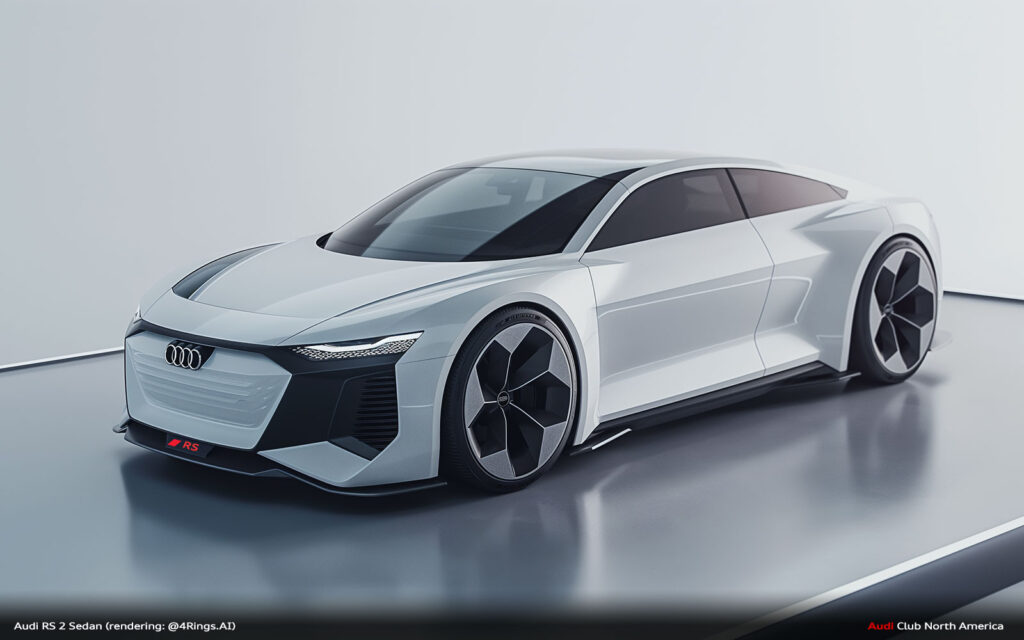
For illustration of this story, we had a few small EV performance sedans. These aren’t real cars just yet, and we’ve not seen anything like this testing. What we show here is purely speculative.


Responses